
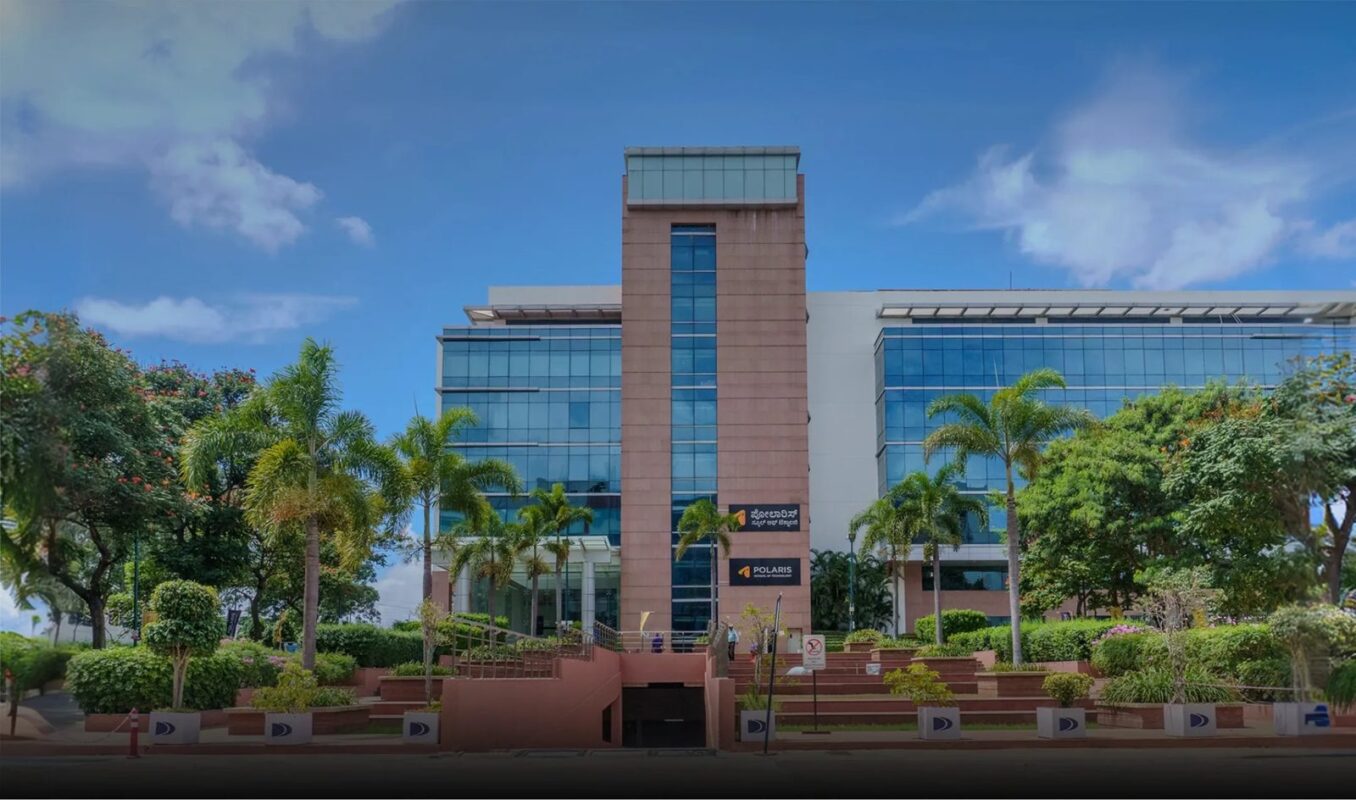
Polaris School of Technology is one of the best colleges for Computer Science in Bengaluru, located within DivyaSree Technopark in the EPIP Zone, Brookefield. Studying inside an active tech park gives students steady exposure to the industry they are preparing to join. The school offers a four-year UG CSE programme with three specialisations: Applied AI Engineering, Product Management and Engineering, and Cloud and Big Data Engineering. The Computer Science degree is awarded through Medhavi Skills University, a UGC-recognised university, with Polaris School of Technology as the industry skilling partner delivering a practical, skills-focused curriculum aligned with NEP 2020.
Admissions at Polaris School of Technology are limited and selective by design, so that every student admitted receives focus and attention. The results of this approach are already visible. A total of 12 PST students have worked with US-based organisations through GSoC, LFX Mentorship and direct internships, including at MIT App Inventor and the Linux Foundation.
For students comparing the best computer science colleges, the process here involves more than clearing an entrance test. Applicants must meet the academic requirements, take the Polaris Admission Test (PAT) or qualify for an exemption, and complete an interview with industry professionals. Scholarships offer another consideration, with financial support available through merit-based and profile-based schemes.
Here is a closer look at the admission process of the UG programme in Computer Science and Engineering at Polaris School of Technology, including the exam pattern, eligibility requirements, cutoffs and financial aid options.
1. Understanding Polaris School of Technology Admissions
Admission to Polaris School of Technology is entrance-based. As with many of the best colleges for computer science, every applicant is evaluated through a holistic review of three things: entrance scores (PAT, or an eligible JEE Main, JEE Advanced or SAT score), the personal interview, and past achievements such as projects, competitions and other work. The aim is to identify students with the aptitude, technical curiosity and potential to succeed in a hands-on CSE programme, rather than to rank them on a single number.
Below are the details of the Polaris School of Technology admission process:
| Admission Requirements | Admission Process |
|---|---|
| Mode of Application | Online |
| Basic Admission Criteria | Educational Records / Marksheet Entrance Exam Scores Personal Interview |
| Application Fees | INR 1,500 |
| Accepted entrance exams | PAT, JEE Main, JEE Advanced, SAT |
| Process | Register online and submit the application form Take PAT or submit an eligible JEE or SAT score Personal Interview Submit required documents and fees Receive admission letter |
2. PAT Exam Pattern and Syllabus
The Polaris Admission Test (PAT) is designed to assess how students think and solve unfamiliar problems, rather than relying only on previously learned concepts. Applicants can choose between two tracks based on their strengths: Aptitude or Coding.
PAT exam pattern
| Feature | Aptitude track | Coding track |
|---|---|---|
| Duration | 120 minutes | 120 minutes |
| Main focus | Mathematical ability and logical reasoning | Coding and analytical problem-solving |
| Question structure | 30 mathematical ability questions, 30 logical reasoning questions and 20 cognitive aptitude questions | 40 coding MCQs, 5 long coding questions and 20 cognitive aptitude questions |
How should students prepare?
The Aptitude track calls for practice in mathematical reasoning, logical problem-solving and cognitive aptitude. Students should focus on understanding the reasoning behind a solution rather than memorising methods for familiar question types.
The Coding track requires a different approach. Applicants should revise programming fundamentals, practise multiple-choice coding questions and work through longer coding problems. Because the test includes cognitive aptitude as well, preparation should not be limited to programming alone.
Polaris School of Technology provides a PAT preparation kit. Reviewing the official material before choosing a track can help students understand the expected format and prepare more effectively.
3. Polaris School of Technology Eligibility Requirements
The eligibility criteria at Polaris School of Technology focus on school qualification, subject background and the admissions assessment. Applicants should check the requirements for their intended intake before paying the application fee.
Below are the Polaris School of Technology eligibility requirements:
| Requirement | Eligibility Criteria |
|---|---|
| Academic qualification | Class 12th from a recognised board with a minimum of 60% |
| Eligible passing years | 2024, 2025 or 2026 |
| Required subjects | Physics, Chemistry and Mathematics (PCM) |
| Nationality | Indian and international applicants can apply |
| Selection route | PAT, or an eligible JEE/SAT score for test exemption, followed by an interview |
4. Polaris School of Technology Cutoffs and PAT Exemptions
Polaris School of Technology admissions run on entrance performance, so cutoffs matter at two points: the PAT and the exemption thresholds for JEE and SAT scores.
PAT cutoff: Applicants without a qualifying JEE or SAT score should clear the PAT with a minimum score, and their result is considered alongside their interview and past achievements.
PAT exemption cutoffs: Applicants with strong JEE or SAT scores can skip the PAT and go straight to the interview stage, provided they meet the cutoffs below.
| Accepted examination | Exam Cutoff |
|---|---|
| JEE Main/Advanced | 90th percentile or above, as stated on the official admissions page |
| SAT | Score of 1,200 or above, taken within the last three years |
Applicants using this route must upload their scorecards for verification, after which the admissions team confirms whether they can proceed to the interview. The exemption covers only the PAT, not the full selection process, so meeting an exemption cutoff does not guarantee admission.
The interview is conducted by industry professionals and covers the applicant’s interests, projects, motivation and reasons for wanting to study technology. Students should be ready to discuss anything they have built or explored.
5. Polaris School of Technology Scholarships and Financial Aid
Polaris School of Technology offers financial assistance through scholarships and fee waivers linked to academic performance, financial need, leadership, gender and entrepreneurial interests. The available schemes and award amounts differ, so students should review the criteria for their programme and intake.
Below are the details of the Polaris School of Technology scholarships:
| Scholarships | Criteria |
|---|---|
| Mukul Rustagi Scholarship for Excellence | Merit-based; awards of up to ₹8 lakh |
| Women in Tech Scholarship | For eligible female applicants; awards of up to ₹5 lakh |
| Sourav Ganguly Young Leader in Tech | For applicants with national- or state-level sporting achievements |
| Classplus Techpreneur Scholarship | For applicants with entrepreneurial or builder profiles |
| PST Merit Waiver | For applicants with a strong academic record |
| PST Need-cum-Merit Waiver | For applicants demonstrating financial need alongside academic strength |
Built for the Few Who Want to Build

Polaris School of Technology does not pretend to be for everyone, and that is the point. It is built for students who want a computer science programme that goes beyond textbooks, and its admissions are designed to find them. A place in the CSE programme is earned through a combination of entrance performance, a strong interview and a record of what you have built or achieved. A good score helps, but it is only one part of the picture.
For applicants shortlisting the best colleges for computer science, the path here is straightforward. Choose the right route, whether the PAT or a JEE/SAT exemption, prepare for the Aptitude or Coding track, and be ready to talk about your projects and your motivation. The effort is not without reward. With scholarships of up to ₹8 lakh available, eligible students can also bring down the cost of the programme.
Frequently Asked Questions
1. What is the eligibility criteria for admission to Polaris School of Technology?
Applicants must have passed Class 12 from a recognised board with at least 60% marks and studied Physics, Chemistry and Mathematics (PCM). Students who passed Class 12 in 2024, 2025 or 2026 are eligible to apply.
2. What is the Polaris Admission Test (PAT) exam pattern?
PAT offers two tracks: Aptitude and Coding. The 120-minute Aptitude test includes 30 mathematical ability questions, 30 logical reasoning questions and 20 cognitive aptitude questions. The Coding track includes 40 coding MCQs, five long coding questions and 20 cognitive aptitude questions.
3. What are the cutoff marks for Polaris School of Technology admissions?
Applicants can qualify for a PAT exemption with a JEE Main score at or above the 90th percentile, a JEE Advanced score meeting the stated 90th-percentile threshold, or an SAT score of 1,200 or above from the previous three years. Applicants who do not qualify for an exemption must take PAT and meet the applicable requirements.
4. Can I get admission to Polaris School of Technology without taking PAT?
Yes. Applicants who meet the specified JEE Main, JEE Advanced or SAT score thresholds can apply for a PAT exemption. They must submit their scorecards for verification and still complete the personal interview. An exemption does not guarantee admission.
5. What is the selection process for the Computer Science UG Program at Polaris School of Technology?
The UG CS Program selection process considers entrance exam performance, a personal interview and previous achievements, including projects, competitions and other relevant work. Applicants can apply online, submit their entrance scores or take PAT, attend the interview, and complete the document verification and fee payment process.
6. What scholarships are available at Polaris School of Technology?
PST offers several scholarships and fee waivers, including the Mukul Rustagi Scholarship for Excellence, Women in Tech Scholarship, Sourav Ganguly Young Leader in Tech, Classplus Techpreneur Scholarship, PST Merit Waiver and PST Need-cum-Merit Waiver. The Mukul Rustagi Scholarship offers awards of up to ₹8 lakh, while the Women in Tech Scholarship offers awards of up to ₹5 lakh, subject to eligibility.
7. What courses and specialisations does Polaris School of Technology offer?
Polaris School of Technology offers a four-year UG programme in Computer Science and Engineering with three specialisations: Applied AI Engineering, Product Management and Engineering, and Cloud and Big Data Engineering. The degree is awarded by Medhavi Skills University, with PST delivering the industry-focused curriculum.
